Lebanese Ministry of Information

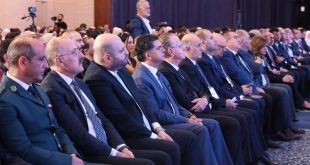
Antonine University hosted an honorary dinner for journalists and media professionals at its Hadath campus, in recognition of their role in supporting the university’s mission.
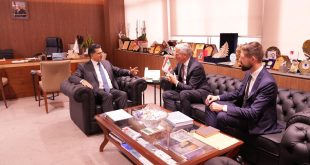
Held at the invitation of University President Father Michel Saghbini, the event was attended by Information Minister Dr. Paul Morcos, Press Editors Syndicate President Joseph Qossaifi, Télé Liban Chairwoman and Director General Dr. Elissar Naddaf, Presidency Media Office Director Rafiq Chalala, Press Club President Bassam Abou Zeid, along with editors-in-chief and media professionals.
In his address, Father Saghbini expressed appreciation for Lebanon’s media community, emphasizing that journalism’s role extends beyond reporting news to safeguarding the public’s right to information, promoting accountability, preserving collective memory and defending freedom of expression.
Under the theme “Humanity at the Heart of Our Mission, Media as Its Voice,” Saghbini stressed that education and journalism shared a fundamental responsibility to serve people, uphold human dignity and promote awareness.
He described the media as a partner in building public consciousness and defending the right to truth, emphasizing the importance of balancing the speed of reporting with accuracy, and freedom of expression with professional verification.
Saghbini also highlighted the shared mission of universities and media institutions in challenging prejudice, encouraging critical thinking and fostering respect for diversity.
He thanked those involved in organizing the gathering, particularly Father Joe Abou Jaoudeh, University Secretary-General Father Jean Alam and media adviser Hanan Merhej.
Concluding his remarks, Saghbini called on journalists to remain committed to truth, human dignity and responsible freedom of expression.
He subsequently presented Minister Morcos with a statue of the Virgin Mary.
Morcos Details Legislative and Institutional Reforms
For his part, Information Minister Paul Morcos outlined an extensive legislative and institutional reform agenda aimed at modernizing Lebanon’s media sector and strengthening the rights and protections of media professionals.
Morcos acknowledged the hardships journalists had faced over the past year, particularly the deaths and injuries caused by Israeli attacks, alongside the continuing economic and social consequences of the war.
He highlighted progress in revitalizing Télé Liban following the appointment of its management, digitizing its archives, modernizing the National News Agency, developing Radio Lebanon and advancing media legislation.
Regarding the new Media Law, Morcos said the ministry was working on its implementation and further development.
He revealed that intensive meetings had been held with the Higher Judicial Council and officials from the Court of Cassation Public Prosecutor’s Office. A further meeting is scheduled for next week with relevant stakeholders and bodies responsible for nominating members of the National Media Authority, under the supervision of the Higher Judicial Council President.
The minister also addressed efforts to secure pension rights for contractual employees who had worked with the Information Ministry and other ministries, following parliamentary approval of the relevant legislation.
Digital Content, Child Protection and Journalists’ Rights
Morcos announced that an advanced draft law had been prepared to regulate the professional and commercial activities of digital bloggers, content creators and influencers.
He emphasized that the legislation would not be finalized before consultations with industry stakeholders and specialists.
On protecting children online, the minister said the Cabinet had established an interministerial committee, at the Information Ministry’s request, to develop a national strategy for responsible internet use and child protection.
The strategy will include legislative proposals and practical measures, with November designated for preparing the necessary recommendations ahead of implementation.
Morcos also revealed that he had completed a draft law providing compensation to the families of journalists killed and to journalists injured in Israeli attacks, comparable to the provisions applicable to military personnel and Civil Defense members.
The draft will be referred to the Legislation and Consultation Authority, followed by the Cabinet and ultimately Parliament.
Film Censorship and Public Broadcasting
Addressing cinematic censorship, Morcos announced the completion of a draft law abolishing prior censorship of films and replacing it with an age-classification system.
He stressed that the guiding principle was freedom of publication and broadcasting, with accountability for violations after they occur rather than prior restrictions.
The minister argued that delaying film screenings on censorship grounds was no longer justified, drawing parallels with the new Media Law’s elimination of prior licensing requirements for publishing houses.
Turning to Radio Lebanon, Morcos said the Cabinet had approved the establishment of a dedicated financial account to provide the broadcaster with direct resources, pending completion of the necessary parliamentary process.
He also referred to proposed legislation requiring state-owned institutions to allocate a specified share of their advertising expenditure to Télé Liban.
Meanwhile, efforts are underway to gradually equip Radio Lebanon with cameras, enabling it to develop into a multimedia broadcaster combining audio and video content.
Social Protection and a Unified National Media Company
Looking ahead, Morcos outlined plans to develop legislation establishing a mutual benefit fund for media professionals, designed to provide pension and social benefits to workers across the sector.
He stressed that the proposal required comprehensive study to ensure a sustainable legal and financial framework.
The minister also addressed end-of-service compensation for public-sector retirees who left active service following the onset of Lebanon’s financial crisis.
He said consultations were ongoing with the Finance and Labor ministries, the General Labor Confederation and the National Social Security Fund to address compensation for employees who retired between 2019 and the increase in the minimum wage in April 2024.
Morcos concluded by announcing plans to revive a proposal to consolidate Télé Liban, Radio Lebanon, the National News Agency and relevant directorates under a unified entity to be known as the National Media Company.
The proposal, previously included in the Media Law before its relevant chapter was removed during the final legislative discussions, would bring official media institutions together under a single digital platform.
Morcos said the initiative would help streamline operations, reduce costs and improve efficiency.
He reaffirmed his openness to proposals and feedback from journalists and media professionals, emphasizing their role in shaping the future of Lebanon’s media sector.