Lebanese Ministry of Information
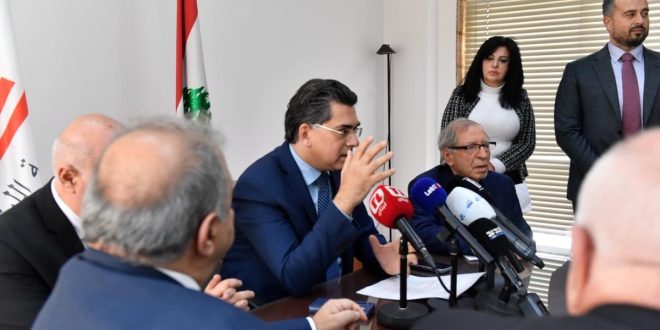
A consultative meeting was held on Tuesday at the Ministry of Information, at the invitation of Minister Dr. Paul Morcos, with the participation of news agencies and electronic websites’ owners to keep pace with the current situation in a manner consistent with the national role of digital media and its resposibility in disseminating and circulating news.
In addition to Minister Morcos, the meeting was attended by the Chairman of the National Audio-visual Media Council, Abdel Hadi Mahfouz; the Dean of the Press Syndicate, Awni al-Kaaki; the Head of the Editors Syndicate, Joseph al-Kosseifi; the Director General of the Information Ministry, Dr. Hassan Falha; and a number of representatives from websites and news agencies.
The meeting began with a minute of silence in mourning for the souls of the journalists who were martyred during the war, in appreciation of their sacrifices in conveying the truth.
In his delivered word, Minister Morcos said: “We meet today in this gathering dedicated to electronic media websites, following the previous meeting held on March 18, 2026 for media institutions, as a continuation of the path of consultation and coordination that we have initiated with the various components of the media sector in Lebanon, and out of comittment to involving all concerned parties in this shared national responsibility.”
Minister Morcos continued: “I thank you for your attendance and for responding to the invitation at a delicate time the country is going through, where challenges are mounting and responsibilities are increasing, particularly in light of the ongoing Israeli aggression and its serious repercussions on Lebanon and its people. We meet today based on our deep belief in the national role played by digital media, which has become a fundamental pillar in reporting news and shaping public opinion, and even in directly and rapidly influencing citizens’ awareness, especially given the widespread presence of electronic websites and social media. In this sensitive phase, the role of the media is not limited to coveying facts, but extends to contributing to the protection of society, safeguarding stability, enhancing awareness, and highlighting the country’s needs, particularly the needs of our displaced people and brothers.”
Morcos added, “What Lebanon is going through today requires the utmost levels of wisdom and foresight, and calls upon all of us to calm tensions and avoid anything that may inflame concerns, incite unrest, or fuel divisions. As you know, words can be a source of reassurance and constructive engagement, but if misused, they can turn into a tool of tension and fragmentation- especially in the digital space where news spreads rapidly and its impacts are amplified.”
The Minister went on to say, “We reaffirm the Ministry of Information’s full commitment to freedom of opinion and expression, which is protected and guaranteed, while emphasizing at the same time that this freedom is always accompanied by responsibility, particularly in critical times that require prioritizing the supreme national interest. We rely on your patriotism, professional expertise, and ethical commitment, and we trust that you will remain, as always, at the forefront of those who protect Lebanon through truthful and responsible words. Let us work together to ensure that our media, across all platforms, is a source of strength and unity, not a cause for concern or division. As promised in the previous meeting, this gathering is part of a series of meetings with various media outlets, underscoring the importance of unifying efforts and exchanging views during this critical phase.”
He also affirmed “a set of principles that were agreed upon during the meeting, which will remain the foundation for media work during this period:
1. Upholding the highest levels of professional and national responsibility in addressing events and developments.
2. Refraining from broadcasting or publishing any content that could stir sensitivities or incitement, or create discord.
3. Caretfully verifying information before circulating it, especially in light of the spread of misinformation.
4. Adopting balanced media discourse, free from hatred and hositlity, that takes into account the sensitivity of the current phase and preserves civil peace and internal stability.
5. Prioritizing everything that strengthens the unity and solidarity of the Lebanese people, highlighting the needs of our displaced brothers and sisters and supporting their resilience in the face of Israeli aggression, and focusing on the positive aspects within society.
He concluded: “All appreciation for your efforts, and we place great hope in your national role during this stage. Lebanon is a responsibility that rests on all of us. Let us rise above our minor differences for the sake of our greater national values. Long live Lebanon, with its free and responsible media.”
At the conclusion of the meeting, the five principles were officially adopted.