Lebanese Ministry of Information
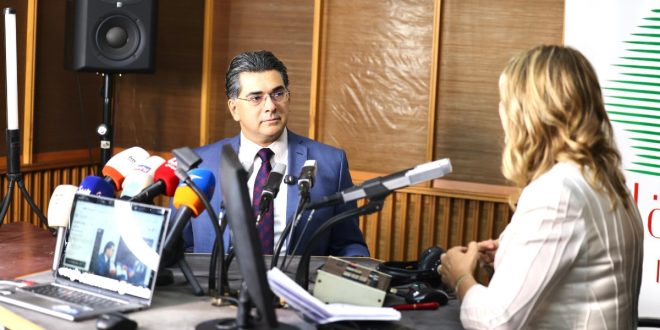
Minister of Information Dr. Paul Morcos, on Monday inaugurated a new chapter in the history of “Radio Lebanon” with the launch of audio-visual broadcasting from the station’s studios.
This initiative marks the introduction of visual broadcasting to the station’s studios, allowing listeners to watch the live studio proceedings while continuing to tune in to the programs.
The event was attended by Dr. Rabih Baalbaki, President of the Educational Technology Syndicate, who donated a camera to the station, along with a number of ministry officials, technicians, and broadcasters from Radio Lebanon.
Minister Morcos was the first person to appear on camera through Radio Lebanon’s new visual broadcast, during a special interview conducted by Programs Director Rita Noujaim El-Roumi from the station’s studios.
The interview addressed the current state of the radio station, its role, and its aspirations for the coming period. The minister announced “the launch of a new path to develop Lebanon’s official radio station and enable it to continue carrying out its media mission, both in audio and visual formats.”
Minister Morcos also thanked fellow media professionals, including photographers, reporters, presenters, as well as the station’s staff, Ministry of Information officials, and technicians who contributed to launching this initiative.
Morcos stressed that “Radio Lebanon is unlike any other station, as it possesses a rich legacy and a tremendous cultural treasure, with historic studios bearing the prominent names. The station has a long-standing record in the fields of art, music, culture, politics, and public affairs in Lebanon and across the Arab world.”
He expressed his happiness at being in the studios to launch this new initiative.
On the national affairs, Morcos called for “adopting a language of love and mutual respect in public discourse.”
Minister Morcos stressed that “work is ongoing to develop Lebanon’s official media institutions,” noting that over the past year and a half, the ministry has completed several dossiers, including reviving Télé Liban, organizing and digitizing its archives, as well as upgrading the National News Agency (NNA) and launching it in a new format around six months ago.
Morcos pointed out that “the recently approved Media Law represents a qualitative step that can serve as a foundation for further development.” He added that “Radio Lebanon is currently undergoing a broad development process,” and praised the efforts of its staff across technical operations, archives, preparation, production, directing, and other fields.
On rapid technological developments, particularly artificial intelligence, Morcos said that “such developments should not become a source of fear or anxiety,” stressing the importance of people knowing how to use and benefit from technology, rather than allowing technology to control them.
The Minister also called for “respect for others and positive dialogue,” stressing that “Lebanese people can freely express their political and social views, provided that individual freedom ends where the rights of others begin.”
Morcos said “Lebanon’s diversity is one of its key strengths,” calling for “ensuring that this diversity does not become a source of division, but rather preserved as a blessing.”
The Minister also stressed that “this stage requires collective action and openness to others.”
On the country’s current national priorities, Morcos stressed that “the priorities are to halt the Israeli attacks, liberate the occupied territory, complete the return of the detainees, rebuild the villages, and enable residents to return to their homes.”
He stressed that “the South is an integral part of Lebanon,” and called for “the highest levels of solidarity and unity in the face of challenges,” emphasizing that “the restoration of state authority and the extension of its sovereignty are the path to salvation and the solution.”
He noted that “President Joseph Aoun is making every effort in this direction through diplomatic contacts, support, mobilization, and pressure, urging everyone to “unify their efforts to achieve the country’s national objectives.”
He stressed that “solidarity and unity are essential to achieving the national objectives,” calling for “rallying around the state and working to restore its role and extend its authority.”